They drove ICE out of Minnesota, now the US government is prosecuting them: solidarity with the Minnesota 15!
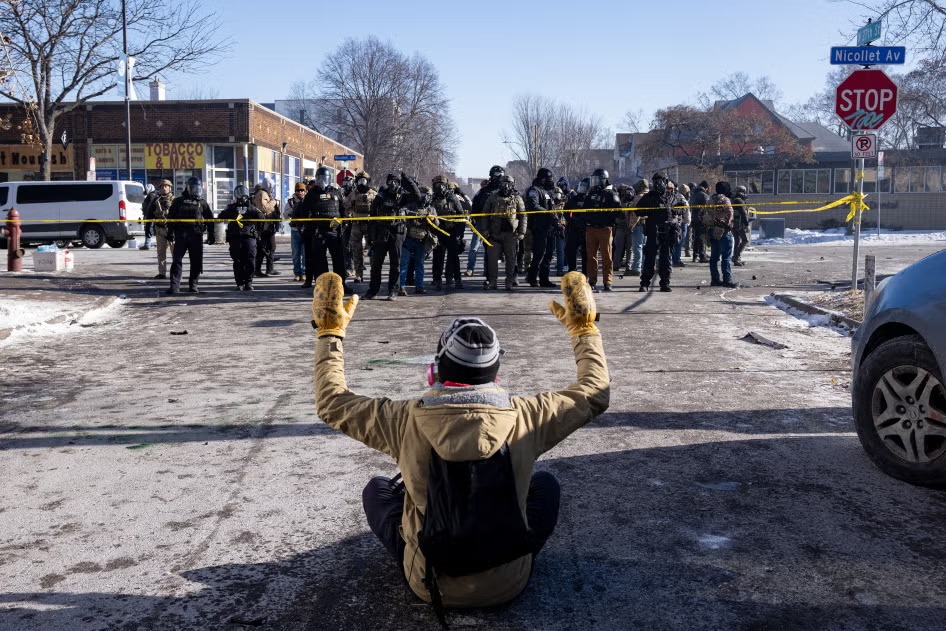
On June 16, a 94-page federal indictment was unsealed in Minneapolis against fifteen activists from the movement that resisted ICE’s occupation of the city between December and January. On July 1, all fifteen pleaded not guilty before the federal court. Among the eight counts, the lead charge is conspiracy to impede or injure a federal officer.
The Minnesota 15 Defense Committee has issued a call for international solidarity, which reached our editorial desk as well. We are relaying it.
What happened in Minnesota
Operation Metro Surge, launched by the Department of Homeland Security on December 1, 2025, brought roughly four thousand federal agents to occupy the Minneapolis-Saint Paul metro area. The government touted it as the largest operation against migrants ever conducted in the United States. Human Rights Watch’s June 18 report on the operation, titled *”A Manufactured Crisis”: Minnesota Communities Terrorized by the Federal Government*, documented unlawful killings, mass detentions, racial profiling, and abusive detention conditions across the operation’s three-month span.
Thousands of people were seized and deported, and thousands more were assaulted; within a few weeks, federal agencies had violated hundreds of court orders. The anti-ICE movement organized itself from below, defending neighborhoods and racialized residents: networks of legal observers, whistle brigades, mutual aid. Protests were already underway when agents began shooting: on January 7, an ICE agent shot and killed Renee Nicole Good, 37, a US citizen, while she was documenting agents’ conduct. Authorities claimed she had tried to run an agent over; video footage contradicts this. DHS Secretary Kristi Noem called it “an act of domestic terrorism”; Vice President Vance said her death was “a tragedy of her own making.” On January 24, Customs and Border Protection (CBP) agents killed Alex Pretti, 37, an ICU nurse, in the street while he was trying to protect a woman being assaulted by agents. Neither the first killing, nor the last. Certainly the last straw.
The response was massive. On January 23, in temperatures as low as -29°C (-20°F), more than fifty thousand people marched through downtown Minneapolis for the ICE Out of Minnesota: Day of Truth and Freedom. No work, no school, no shopping: more than seven hundred businesses shut down. It was, in effect, the first general strike in the United States since the Taft–Hartley Act of 1947. In April, the Trump administration announced the end of Metro Surge. The streets had won.
The indictment
The indictment describes many of the defendants as anarchists and antifascists (Antifa) — two categories the White House’s latest counterterrorism strategy classifies as terrorist groups. They are charged as members and associates of Direct Action Minnesota, which the Department of Justice has presented as a direct-action group with ties to Antifa. The indictment itself describes the organization as “dedicated and committed to direct action against federal law and immigration enforcement.” Acting Attorney General Todd Blanche went further, characterizing the defendants’ conduct as “an unrelenting campaign of harassment and violence targeting federal and local law enforcement.” This is a criminalization campaign that, alongside the resurgence of socialist demands even in America, is sliding into openly anti-communist rhetoric meant to justify neofascist policies and the defense of the most unrestrained capitalism. The framework is NSPM-7, the presidential memorandum through which the administration directs federal agencies against its political opponents, together with the executive order designating antifascism as a domestic terrorist organization — a designation that exists in no statute.
Many of them, the Defense Committee writes, are union militants who played a decisive role in organizing the January 23 general strike. The evidence? Signal messages and social media posts. The indictment lists 269 “overt acts,” including posting opinions on Facebook, attending a demonstration, taking part in meetings, wearing certain clothing. At least nine meetings turn out to have been infiltrated by informants or federal agents — among them the workers’ assembly held at the United Labor Center in Minneapolis on February 15, which the indictment itself cites as conspiracy evidence, as Labor Notes/Workday Magazine documented. Minnesota’s labor movement responded quickly: AFL-CIO President Bernie Burnham said of the Trump administration, “They failed. Now they are trying to break us in the courtroom.” The document contains 53 references to “unindicted co-conspirators.”
The raids tell the rest of the story. Cal Robinet, 37, a union electrician, told Unicorn Riot he was woken at six in the morning by agents in military gear pointing assault rifles at his head, then dragged outside in his underwear in the rain while a Department of Homeland Security film crew recorded everything. Agents held the younger residents of the house — a shelter for trans people, targeted for exactly that reason, according to Robinet — at gunpoint, and rifled through his partner’s underwear drawer. Robinet said what the government calls Antifa is a boogeyman that doesn’t exist, and that they’re simply “going after anybody who says no to them.” Isaac Sant, 36, a healthcare worker and the lead name on the indictment, also charged with interstate stalking for having observed federal agents headed to Wisconsin, pointed out that if what he’s accused of is criminal conspiracy, then so are the roughly 350,000 people who took part in the resistance. Defense attorney Jordan Kushner has argued the case extends the government’s repressive conduct from the community directly into the courtroom. Sant has already announced he will reject any plea deal not offered to all of his co-defendants.
The same day the indictment was unsealed, prosecutors filed a motion to have the case declared complex: twenty terabytes of material and ninety additional days before handing over evidence to the defense. On July 1, the judge denied it. Among the release conditions is a no-contact order between co-defendants, who can only speak to one another through their lawyers. It’s not an isolated episode: of the roughly thirty-six people charged in Minnesota during Operation Metro Surge for allegedly assaulting or impeding federal agents, eighteen have already had their cases dropped, according to reporting drawing on MPR News data. Pressed on how the new indictment would hold up given that track record, U.S. Attorney Daniel Rosen insisted he didn’t think “any cases have failed in any way.” Meanwhile, federal prosecutors in Minnesota have resigned en masse.
Why these arrests concern us
This repressive grammar concerns us because it is an expression of a generalized repression: wherever people mobilize against fascist violence, governments close down democratic space. In Italy, this is the case with the Palestine movement: Palestinian organizations are targeted, along with activists connected to social centers, movements, and unions. The objective is always the same: strike those who organize, who can move the streets, who are recognizable, who are already marginalized, who are racialized. And make an example of them, so that social uprisings like those of last fall in Italy can never happen again.
The repression of the anti-ICE movement concerns us even more closely following the entry into force of the new EU Migration and Asylum Pact this past June 12. The Pact liberalizes, on a continental scale, practices entirely similar to ICE’s: behind a rhetoric of “mandatory solidarity” lie raids reaching into private homes on mere suspicion of irregular status, mass administrative detention, deportations to “safe” countries of origin or even “safe” third countries, biometric screening from age six up, and much more.
That ICE is a model, not an American anomaly, is not a metaphor. Greg Bovino, the man who directed much of Operation Metro Surge, resigned in March. On May 30, he was the guest of honor at a European far-right conference in Portugal dedicated to “remigration,” where he described Austrian white supremacist Martin Sellner as a friend, telling him onstage that “those ideas mirror each other.” He has just opened an exploratory committee for a 2028 presidential run. America’s muscular anti-migration policies, condemned only in words, are already here.
Not to mention the “Remigration and Reconquista” bill that has reached the Italian Parliament after collecting 150,000 signatures.
So what the Minnesota movement built — the fusion of unions, migrant communities, and neighborhood solidarity, culminating in the general strike that drove federal agents out of the state — could be the future of the movement against remigration in Italy and Europe. A convergence of this kind can only draw a backlash.
What we can do
The Minnesota 15 Defense Committee is asking for statements of support from organizations, contributions to the legal defense fund, amplification of the defendants’ voices, and solidarity actions wherever people are. But above all, it is asking people to mobilize. Sant, one of the arrested activists, stresses that the most important thing, far more than donating, is to keep taking to the streets. To keep documenting and fighting. Because that is exactly what the Trump administration wants to stop. And Robinet adds: don’t be surprised when it’s your turn.